

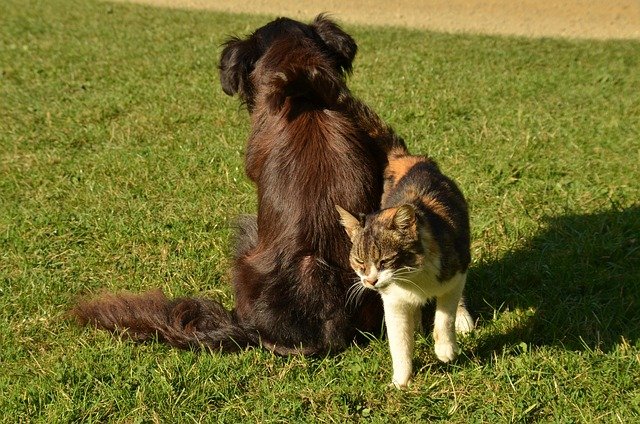
A dog chasing the family cat can look like harmless fun until someone gets scratched, cornered, or worse. Chasing also tends to snowball. As Best Friends Animal Society puts it, chasing is self-reinforcing: the more the cat runs, the more the dog wants to chase.
That means waiting it out rarely works. This guide lays out a step-by-step plan built on guidance from the AKC and Best Friends, from resetting the household to teaching your dog a calm default around the cat.
Why Dogs Chase Cats
Key point: chasing is usually play, prey drive, or excitement, and each needs a slightly different level of caution.
Some dogs chase because a running cat looks like a great game. Others have a stronger predatory pull, with intense staring, stalking, or freezing before they launch. Puppies often chase simply because they have no impulse control yet; the AKC GoodDog! Helpline notes that puppies “don’t know when enough is enough.”
| What you see | What it often means | How careful to be |
|---|---|---|
| Loose, bouncy body, play bows, backs off when the cat stops | Play or excitement | Manage and train |
| Barking and chasing, stops when the cat hides | Arousal and frustration | Manage closely, train at a distance |
| Hard stare, stiff body, stalking, silent pursuit | Prey drive | Strict separation, get professional help |
I’ll be honest: that third row is the one I’d take most seriously. If your dog fixates silently and ignores food around the cat, bring in a certified trainer or veterinary behaviorist before going further.
Step 1: Reset the House So Chasing Can’t Happen
Key point: every chase is practice, so stop the practice first.
- Give the cat a dog-free zone. The AKC recommends a gated area with the litter box, food, water, bed, toys, and a scratching post.
- Add vertical escape routes. Tall cat trees and shelves let the cat leave without running along the floor, which is what often sets off a chase.
- Feed the cat out of the dog’s reach, such as on a counter or behind a gate.
- Use a leash or drag line indoors during the training period so you can stop a chase before it starts.
If your dog does chase, Best Friends suggests calmly removing the dog to a quiet space such as a crate or bathroom for about one to two minutes, then letting them out in a low-key way. No scolding needed. The point is simply that chasing makes the fun stop.
Step 2: Start Over With a Slow Introduction
Key point: even if they already live together, a reset introduction helps.
AKC trainer Stephanie Gibeault outlines a gradual process that works well as a “do-over” for pets who got off on the wrong foot.
- Swap scents. Place the cat’s bedding near the dog’s food bowl and pair it with treats.
- Feed on opposite sides of a closed door, starting a few feet back and moving the bowls closer over several days.
- Move to a visual barrier such as a baby gate or screen door once both are calm at the door.
- Hold short leashed sessions in a shared room with the cat free to move and leave. The AKC suggests brief sessions several times a day for at least a week.
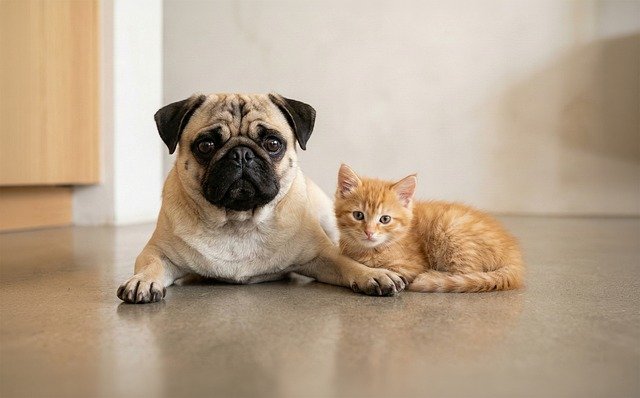
The goal is boring coexistence: two animals in the same room, neither one on alert.
For the dog side of first meetings, the same slow principles apply as in our guide to introducing a new puppy to a resident dog.
Step 3: Reward Your Dog for Looking Away
Key point: pay your dog every time they choose you over the cat.
This is the heart of the plan, and both the AKC and Best Friends recommend it. With your dog on leash and far enough away to stay calm, wait for them to glance at the cat and then look away. The moment they look away, mark it (“yes!”) and give a high-value treat.
Repeat often. Over time the cat becomes a cue to check in with you instead of a reason to launch. Useful add-ons:
- “Leave it” to mark the cat as off-limits. Our leave it guide covers the steps.
- A settle behavior like lying on a mat while the cat moves around. See our place command guide.
- Redirection to a toy if your dog gets bouncy. The AKC suggests redirecting chase energy into games like fetch.
Don’t forget the cat. Best Friends recommends giving the cat treats while the dog is in view, so the cat also learns the dog predicts good things.
Step 4: Drain the Chase Energy Elsewhere
Key point: a dog with no outlet will make the cat the outlet.
Chasing is often a symptom of too little exercise or mental work. Give your dog legal ways to run and hunt: fetch, flirt-pole games, nose work, food puzzles, and sniff walks. Best Friends also suggests giving chews in a separate room so the cat isn’t near valued items.
Green Lights and Red Flags
Key point: read both animals, not just the dog.
Moving through the steps too quickly is a common reason this kind of training stalls. Use body language to decide when to progress and when to back up a step.
- Green lights: your dog can take treats easily with the cat in view, looks away on their own, and lies down or sniffs around instead of staring. The cat walks through the room at a normal pace, eats, and grooms.
- Yellow lights: your dog whines, stares for several seconds, or needs repeated cues. Add distance and shorten sessions.
- Red flags: your dog refuses food, trembles with focus, lunges, or stalks. The cat hisses, hides for long periods, stops eating, or avoids the litter box. Stop and separate fully, then talk to your vet or a certified behavior consultant.
Cats often show stress quietly, so a cat that “seems fine” but has moved in under the bed is not fine. Their comfort sets the pace as much as your dog’s progress does.
Measure It: A Weekly Cat-Chase Scorecard
Progress with pets living together can be subtle. A quick weekly tally tells you whether to move forward or slow down.
| Week | Chase attempts | Look-aways rewarded (per session avg) | Closest calm distance (feet) | Cat’s behavior (hiding / neutral / relaxed) |
|---|---|---|---|---|
| 1 | ||||
| 2 | ||||
| 3 | ||||
| 4 |
Watch the last column as closely as the dog’s numbers. A cat that stops hiding is one of the best signs things are working.
Wrapping This Up
To stop a dog from chasing the cat, block the chases, reset with a gradual introduction, and reward your dog heavily for looking away. Give the cat height and a dog-free retreat, and give your dog better outlets for chase energy.
The AKC notes supervision may be needed for weeks or even months before unsupervised time is safe. Having looked at how many steps are involved, I think that range is realistic, and it’s better to go slow than to undo progress with one bad chase.
Common Questions
Can a high prey drive dog live with a cat?
Some can, with careful management, but not all. Silent stalking, fixation, or ignoring high-value food around the cat are signs to get a professional assessment before continuing.
Should I let them “work it out”?
No. Chasing is self-reinforcing, and a cornered cat can be injured or can injure the dog. Keep them separated when you can’t supervise.
My dog only chases when the cat runs. Is that okay?
It’s common, and it’s why escape routes and vertical space help so much. Train the look-away when the cat is moving slowly, then build up to faster movement.